
Sri Lanka, known as Ceylon until 1972, is a teardrop-shaped island nation off the southern tip of India with a history as layered as its famous spiced curries. For over two millennia, the island has been a hotbed of trade, attracting Arab, Portuguese, Dutch, and British colonizers drawn by its precious cinnamon, gemstones, and strategic position along ancient maritime routes. This succession of influences has left a mark on the island’s architecture, languages, and religious tapestry, where the country’s religions include Buddhism, Hinduism, Islam, and Christianity. Today, Sri Lanka is home to diverse communities including the Sinhalese majority, Tamil population, and descendants of Arab traders known as Sri Lankan Moors, each contributing distinct flavours to the nation’s cultural and culinary identity.
Sri Lankan cuisine has advantages for celiacs; much of the food in the country revolves around rice, with red rice, white rice, and rice flour figuring prominently. From the delicate lace of string hoppers to fluffy idlis and coconut-rich curries, many traditional Sri Lankan dishes are naturally gluten free. However, wheat flour is also present, particularly via popular fried snacks and street foods. Bouillon cubes, which often contain wheat, are common in many kitchens; brands like Maggi are common, and they appear in everything from curries to kottu. Perhaps more challenging than the ingredients themselves is navigating cross-contact in busy restaurants and street stalls, where the same oil can fry samosas and gluten free items — and gluten free as a concept isn’t well understood.
This guide was built with gluten free travellers and exists to help you eat safely and well in Sri Lanka. I’ve created translation cards in both Sinhala and Tamil with input from translators who have familiarity with celiac disease and who understand the local food landscape. You’ll find detailed information on safe dishes, ingredients to watch for, and how to communicate your needs.
Wishing you safe and delicious travels!

What should celiacs know when travelling to Sri Lanka?
As a celiac, it is important to be proactive when planning a trip to Sri Lanka to ensure that you have access to safe and gluten free food options. Here are a few things to consider:
- Be aware of cross-contact risks. As with dining elsewhere in Asia, foods fried in the same woks, or on the same grill, may create risks for celiacs.
- Read up on safe street food dining. After years of eating on the street, I wrote a guide to eating at food stalls safely, which doesn’t refer to gluten but to choosing stalls that will minimize any risks of food-borne illness or stomach upset. These rules apply to any country I’ve visited, and have helped me avoid getting sick on the road.
- But in those stalls, beware of oil that has had prior contact with gluten. Street food snacks like vada are a prime example. While the snack itself is usually made from gluten free lentils and gram (chickpea) flour, it is almost always fried in the same oil as wheat-based samosas or roti, making it unsafe for a celiac. Unless you can verify a dedicated fryer, it is safest to avoid all deep-fried street foods.
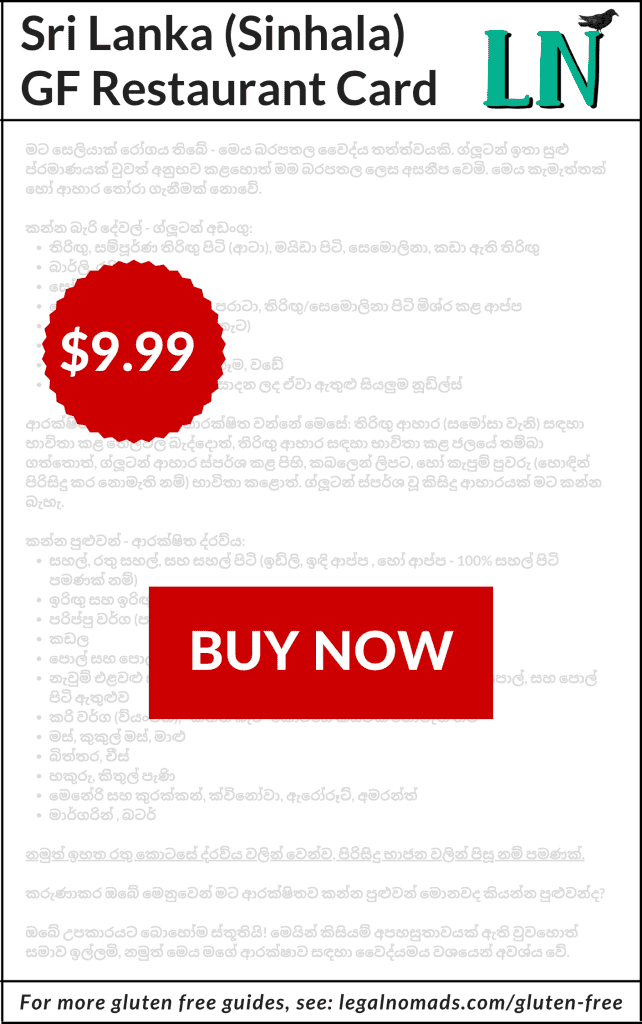
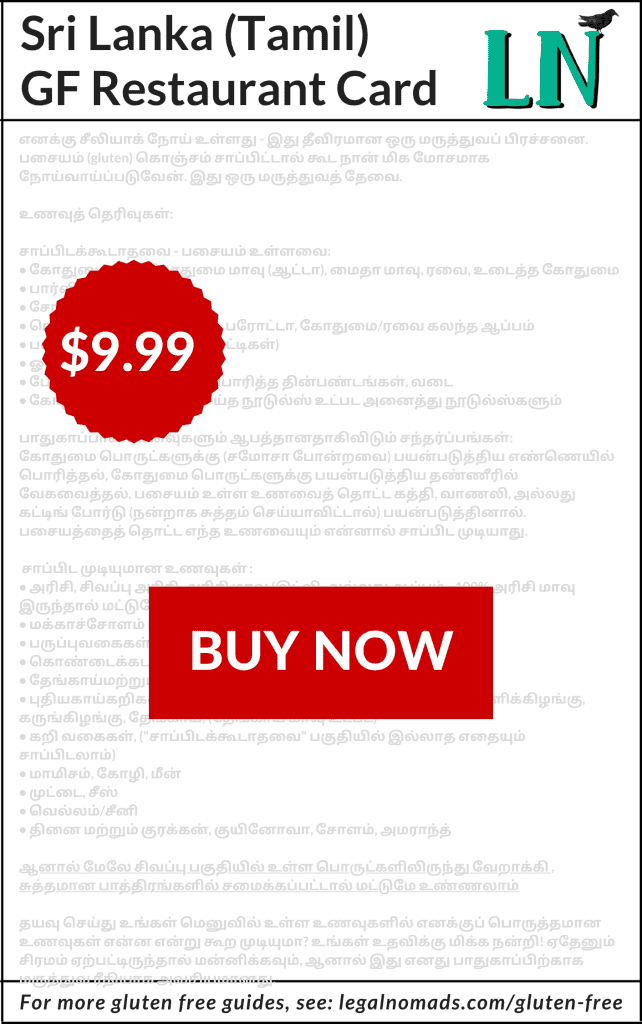
- Bring a detailed gluten free card for Sri Lanka. Yes, I made my own, because existing ones weren’t as detailed as I needed as a sensitive celiac. (See below) For Sri Lanka, you get two languages for the price of one, since it’s crucial for travellers to have both Sinhala and Tamil on their wanders. The term “gluten free” is not widely understood in Sri Lanka and is unlikely to get you the clear answer you need. Your communication must be specific, which is why the translation card is so crucial.
- Try to eat at the beginning of peak hours, to communicate your needs. When travelling with a food restriction or allergy, communicating your needs is imperative, and doing so when someone has the patience to read your card is also sometimes a challenge. When in markets or at street stalls, or even restaurants, I tried to go just when they opened so that I could present my card and explain what I needed but not during their big rush period for dining. A crowded food stall won’t likely have the time to cater to me mid-dinner or lunch rush; it was always better received — and more fruitful! — to be strategic about when I visited. You don’t want to go late off-peak because the food will have been sitting out for hours, as my Street Food Guide above notes. Heading there early always made it easier for me.
- While authentic Sinhala and Tamil cuisine is overwhelmingly based on rice and other gluten free flours, today eating ‘traditionally’ gluten free dishes isn’t a guarantee. That’s because many spots (especially in upscale tourist-focused restaurants) may add wheat flour to hopper and string hopper batter to make it cheaper or easier to work with. Similarly, curry sauces might be thickened with wheat flour.
- Embrace the rice and coconut. Amid these warnings, there is much to eat. Rice is plentiful, including delicious and nutritious red rice, which are safe. Coconut is used a lot in Sri Lankan food, from creamy coconut milk as the base of curries, to grated coconut insambols, and coconut oil for frying.
- Sometimes there is soy. While soy sauce is far less common in Sri Lanka than in Southeast Asia or East Asia, it does appear, particularly in Chinese-influenced dishes, “short eats”, and stir-fries like kottu roti, as well as some meat marinades. Always confirm its absence in these types of dishes.
Detailed gluten free restaurant cards for Sri Lanka
Sri Lanka is a multilingual nation where language reflects both geography and community. Sinhala (සිංහල) is spoken by approximately 75% of the population, primarily among the Sinhalese Buddhist majority concentrated in the southern, western, and central regions of the island. Tamil (தமிழ்) is the first language for about 15% of Sri Lankans, including the Tamil Hindu population predominantly in the Northern and Eastern provinces, as well as those whose ancestors came as tea plantation workers during British colonial rule.
For celiacs travelling in Sri Lanka, carrying both Sinhala and Tamil translation cards is essential. While you might manage with just Sinhala in the south and west, the northern and eastern regions require Tamil; even in mixed areas, kitchen staff may be more comfortable reading one language rather than the other. Restaurant workers, street food vendors, and guesthouse cooks are the people who need to understand your dietary restrictions, and they may have limited English even when front-of-house staff are fluent.
Those who purchase the Sri Lanka cards will receive both Sinhala and Tamil cards, so you have what you need to communicate your needs as a celiac in the country.
Note: The card is available for purchase via Gumroad, a trustworthy 3rd party site that uses Stripe, so you know your information is safe.
Why is this gluten free card for Sri Lanka different?
I used several different translation cards on my travels, and I still got sick. I may be more sensitive than some celiacs, but even a small amount of oil for frying that had contact with gluten, or wheat-thickened sauce in the food, is enough to make me ill for days. Let alone the joint pain later that week, and the fatigue. And regardless of whether we feel it or not, ingesting any amount of gluten is a problem if we are celiac.
Why choose a Legal Nomads detailed gluten free restaurant card?
✅ Each card is carefully crafted by someone with celiac disease, and then goes through 2 sets of translations to ensure accuracy.
✅ Unlike shorter, less-detailed cards, each card lists out local ingredients and dishes that have hidden (and not hidden!) gluten in them. Saying “I can’t have gluten” just isn’t usually enough to keep celiacs safe — many people preparing your food don’t know what ingredients have gluten in them.
✅ It expressly mentions that we cannot eat food from pans, shared fryers, or cooking surfaces that have had cross-contact with gluten.
✅ To ensure the card is taken seriously, it adds an apology for the inconvenience, and emphasizes that avoiding gluten is a medical obligation — not a choice.
✅ It is instantly downloadable in both PNG and printable PDF file formats, to help you eat safely as you travel.
Eating gluten free in Sri Lanka: dishes, desserts, and more
Naturally gluten free in their traditional form, but as always, confirm no wheat flour, soy sauce, or stock cube has crept in.
- Habala pethi (in Sinhala) or aval (Tamil): a flattened or flaked rice similar to poha in India. In Sri Lanka it turns up as a porridge (habala pethi kanda) and as a sweet snack tossed with coconut and jaggery. Naturally gluten free, but double-check that any spices or additives stirred in are, too.
- Kola kenda: a traditional herbal porridge of red rice, coconut milk, and green leaves such as gotu kola, often taken at breakfast. Naturally gluten free.
- Kadala: chickpeas boiled soft, then tempered with onion, pieces of coconut, curry leaves, and spices. A naturally gluten free breakfast or snack that’s good on its own.
- Hoppers/appam: a bowl-shaped, lacy crepe (called appa in Sinhala and appam in Tamil). Traditional hoppers are gluten free, made from a fermented batter of rice flour and coconut milk, but you should always check the ingredients; some restaurants, especially in large hotels, stretch or replace the batter with wheat flour. Check to make sure it’s 100% rice flour; otherwise, these are unsafe.
- String hoppers: steamed nests of rice-flour noodles, known as idiyappam in Tamil and indi appa in Sinhala. Naturally gluten free, but again check that no wheat flour was blended into the dough.
- Curries: so many delicious curries to choose from. Confirm with your cook that no soy sauce, wheat flour, or bouillon cube was used in the preparation. Enjoy curries such as parippu (red lentil dhal, the everyday staple), polos (young jackfruit), kukul mas (chicken), ambul thiyal (a dry, intensely sour fish curry preserved with goraka), and wattakka (pumpkin curry).
- In the curries category, don’t miss cadju maluwa, cashew curry, with cashews simmered in a mild, golden coconut gravy, a naturally gluten free Sri Lankan specialty. It’s so tasty I had to give it its own entry.
- Grilled seafood: along the south coast, ocean-facing restaurants let you pick the day’s catch to be grilled or baked. Plainly cooked seafood is one of the safest meals for a celiac; just confirm no soy or seasoning sauce is brushed on during cooking.
- Dosa: also called thosai in Sri Lanka, dosa are thin, savoury crepes. They are gluten free if made only from lentils and rice, so check that no other non-GF ingredients (such as wheat) have been added.
- Pittu (also written puttu): a steamed dish of rice flour and grated coconut, pressed into a cylinder in a bamboo or metal mould, served hot with curry, coconut milk, or sugar. Traditionally made from rice flour and coconut, but check that wheat flour wasn’t used. A kurakkan (finger millet) version is also common and is likewise gluten free when not cut with wheat.
- Papadam: a thin, crispy wafer made from lentil flour (usually urad/black gram). It’s important to check with the restaurants, as some commercial varieties are sometimes made with wheat flour. Your translation card will definitely come in handy when ordering.
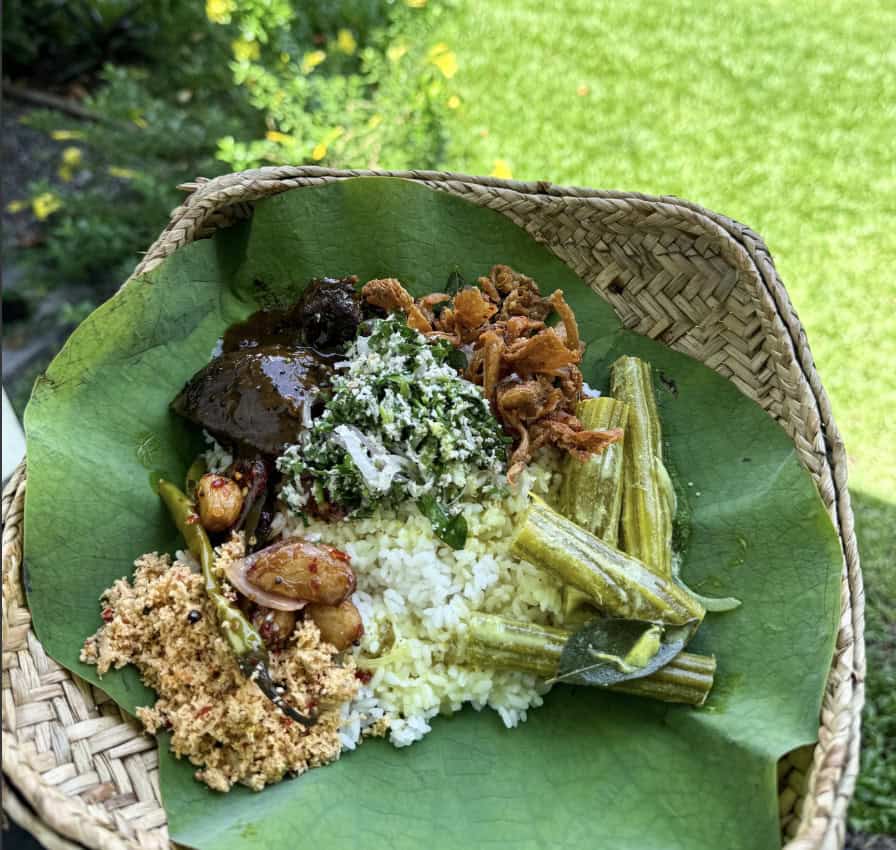
- Thali: a rice-and-curry plate, often featuring rice surrounded by multiple bowls of curries and other accompaniments. Depending on the style, your options will vary, but overall, it’s a very safe choice for my stomach. Keep in mind that even if the plate comes with a wheat roti, you can almost always ask for extra rice or a papadam instead.
- Lassi: a creamy yogurt-based drink. Extremely refreshing, it comes in many flavours, but mango is the most common in Sri Lanka.
- Sambol: a family of fresh Sri Lankan relishes. The classic is pol sambol (coconut sambol), made from grated coconut, red chilli, lime juice, Maldive fish (dried, cured tuna), and salt. Lunu miris, a fiery pounded paste of red onion, chilli, and Maldive fish, is another staple. These are naturally gluten free, though if Maldive fish is included, confirm it has no added wheat or flavour enhancers.
- Seeni sambol: a sweet, caramelized onion chutney or relish.
- Wambatu moju: a classic relish made from fried eggplant strips, shallots, and green chillies mixed with mustard and vinegar for a pickled effect.
- Biryani: a rice dish often served at special occasions. A Sri Lankan biryani differs from an Indian one in that the rice, curried meat, onion sambol, and boiled egg are served alongside one another, rather than being cooked together.
- Kiribath: Sri Lankan milk rice. Authentic kiribath contains only rice, coconut milk, and salt. It’s often served with seeni sambol.
- Idli: a fluffy, fermented rice cake that is a staple of Tamil cuisine, often served for breakfast. Avoid rava idli, which is made with semolina (a wheat product).
- Watalappam: a rich, steamed custard of coconut milk, eggs, and kithul or jaggery (palm sugar), spiced with cardamom and nutmeg. A beloved Sri Lankan dessert, especially within the Muslim community, and naturally gluten free. Confirm no semolina or flour was added as a thickener.
- Gotu kola sambol: a finely shredded salad of pennywort leaves tossed with coconut, lime, shallot, and chilli. Fresh, green, and naturally gluten free.
- Mallung (mallum): lightly cooked shredded greens tossed with grated coconut, turmeric, and lime. Naturally gluten free and found at most rice-and-curry spreads.
- Kiri hodi: a mild, soupy coconut-milk gravy seasoned with turmeric, onion, curry leaves, and lime, often poured over rice or string hoppers. Naturally gluten free, but confirm no bouillon cube was used to season it.
- Curd and treacle: thick buffalo-milk curd (mee kiri) drizzled with kithul palm treacle. A simple, wonderful, naturally gluten free dessert.
- Traditional festival sweets such as kokis (a crisp rosette of rice flour and coconut milk), kavum (an oil cake of rice flour and treacle), and aggala (rice-flour and treacle balls) are traditionally gluten free. Two cautions: some modern recipes blend in wheat flour, and the fried ones (kokis, kavum) carry the usual shared-oil cross-contact risk.
- Lavariya: a sweet cousin of string hoppers, where the rice-flour nests are filled with pani pol (coconut cooked with treacle and cardamom) and rolled up. Because the base for these sweets is rice flour, lavariya is naturally gluten free, unlike the wheat commonly used for pani pol that is on the unsafe list below.
Gluten free restaurants and shops in Sri Lanka
Gluten free restaurants in Colombo
- Kemara Cuisine is a 100% gluten free establishment with a spa and boutique on-site as well, so you can spend the day enjoying the facilities as well as your meals. On the food front, there is a rotating menu of gluten free choices for breakfast, lunch, and dinner, including an assortment of burgers, soups, noodles, pasta, pizza, and so much more. There are also quite a few Sri Lankan dishes such as gluten free versions of roti, kottu, and Sri Lankan curries, as well as juices and smoothies made from local fruits and vegetables (try the watermelon mint juice or the tropical turmeric smoothie). Before you go, stock up on GF bread, wraps, cookies, cakes, and other staples, especially if you’re travelling to another part of Sri Lanka that may not have as many options for gluten free food.
- FernanDough Gluten Free Bakers is found in Nugegoda, a suburb of Colombo. As the name suggests, it is a totally gluten free bakery, serving a selection of bread, “gluffies” (mini donuts), and GF flours. Flavoured breads include options like dates, rosemary and chili, and garlic and curry leaf, and you can stock up on sweet gluffies with icing sugar, cinnamon sugar, or chocolate to take away as well. Their baking is done on Tuesdays and Fridays, if you want the freshest picks!
- Monsoon Colombo is a stylish restaurant that is highly recommended by celiac travellers for its helpful, accommodating staff who understand gluten restrictions. They can guide you through the menu to ensure a safe and flavourful meal.
- Ranbath Organic is a welcoming restaurant that serves 100% gluten free, vegan food in the city. Focusing on authentic Sri Lankan food, expect lots of fresh, vibrant flavours, especially when it comes to their tasty curries and dishes such as GF kiribath, kohila, hoppers, gotukola salad, fried pumpkin, and so much more. Also serving açai bowls, pancakes, smoothies, and a variety of desserts, they make their own flour from a combination of rice, chickpea, and millet flours.
Gluten free restaurants in Kandy
- Balaji Dosai is a popular South Indian restaurant found in Kandy that has lots of gluten free options, with GF items clearly marked on the menu. Enjoy large portions of dosa, curries, and more, including GF uttapam and dhal vada. The staff is knowledgeable about celiac disease and can answer your questions; however, as it is quite a busy restaurant and not fully gluten free, make sure to communicate clearly using your card that cross-contact is an issue.
- Soul Food is a welcoming little spot for when you’re craving Western food. While the GF menu isn’t huge, it does have a few options, including rice bowls and smoothie bowls. The staff is also well-informed about gluten and can point out the safe items to eat.
Gluten free restaurants in Galle & The South Coast (Unawatuna, Weligama, Mirissa)
- Shady Lane is a vegetarian restaurant located in the beach town of Mirissa that’s incredibly popular with surfers. While not a fully gluten free establishment, there are GF options available, including GF bread made with sunflower seed flour, which is then used in their French toast, avocado toast, and other dishes. Also enjoy GF burrito bowls, salads, smoothies, and more.
- Rise is an Italian restaurant in Weligama that has numerous GF options, including pizza and bread. Made from rice and gram flour and cooked in a separate oven, the pizza is very popular with celiacs, and the staff is on top of it when it comes to safety and cross-contact. Open Tuesday through Sunday for dinner only.
- Moochie’s has two locations in Sri Lanka, one in Weligama and one in Ahangama. With lots of GF options and a very knowledgeable staff, this is a popular spot for celiacs. Enjoy their excellent selection of healthy smoothie bowls, salad bowls, fish dishes, and more, with items marked either GF or GFO (the latter for when there’s a gluten free option or substitute available for the dish). There’s also a fantastic selection of coffee drinks, fresh juices, smoothies, cocktails, and mocktails.
- Dumplings Cafe in Galle has a few GF options, namely their delicious namesake. It’s a cozy little spot that’s also good for a quick coffee. Open daily from 9 am until 9 pm.
Gluten free restaurants in Ella and the Hill Country / Central Highlands
- Cafe Chill is a popular spot with tourists in Ella, and, while not fully gluten free, GF items and dishes with GF options are clearly marked on the menu. Enjoy Sri Lankan favourites such as lamprais, or the rice and curry of the day. Other options include falafels, grilled fish, steak, and marinated tofu. There is reportedly a separate gluten free fryer, and the staff are quite well-informed about the dangers of cross-contact.
- Ak Ristoro is an Italian restaurant in Ella that has GF items marked on the menu, including a selection of pastas. While not a fully gluten free restaurant, the staff are knowledgeable about celiac disease and GF meals are prepared separately.
- Honey Bee Garden (Google Maps link) comes highly recommended by celiacs. This small guesthouse has a restaurant with many gluten free options, including many of the curries and maize flour rotis. Why many people visit, however, is for the excellent cooking classes; owner Ruwini is very knowledgeable about cross-contact and can tailor the class to have gluten free options. A fun (and delicious) activity to try when in Ella.
Dishes that have gluten in Sri Lanka
- Roast paan: a thin, crisp-edged wheat bread (the name is “roast,” for the toasted loaf it’s cut from) eaten at breakfast with pol sambol and dhal. Wheat-based, so off limits, though the pol sambol and dhal beside it are usually safe.
- Rotis: Wheat-based flatbreads that you’ll find all over Sri Lanka. Sadly, a no-go for us celiacs! The thin, stretchy version chopped up to make kottu (below) is called godhamba roti and is also off-limits.
- Chapati: Another name for roti.
- Naan: Another wheat-based flatbread, often served with curries.
- Samosas: A fried treat that is unfortunately unsafe for celiacs, as the pastry is made from wheat flour, often included in the “short eats” category, described below.
- Wade, vade, vada, vadai: Called by many names in Sri Lanka, these are lentil fritters that are naturally gluten free. However, because they’re a common street-food snack, there is often concern about cross-contact, especially if they are fried in the same oil as wheat-based snacks.
- Imarti: Also called jangiri, these are a deep-fried sweet often shaped into intricate patterns. While naturally gluten free – they’re made from urad dal (black gram) batter – the risk is cross-contact, as many shops deep fry all items in the same oil, including wheat-based items.
- Hoppers or string hoppers that aren’t made from rice flour: Traditional hoppers (appam) are made from rice flour and are naturally gluten free, but some restaurants and hotels add wheat flour to the batter. Always check the ingredients before eating.
- Papadam if store-bought: Although naturally gluten free when made from lentil flour, store-bought papadam often have wheat flour. Check the ingredients before consuming.
- Pani pol wrapper: the sweet treacle-and-coconut filling itself is gluten free, but it is often rolled inside a wheat-flour pancake, which makes the finished dish sadly unsafe. Recipes abound for those who want to try it at home; swap out all-purpose wheat flour and use a 1:1 baking flour instead. For a version you can try, opt for lavariya, listed above.
- Kottu (kottu roti): perhaps the most well-known Sri Lankan street food, made by chopping godhamba roti (a wheat flatbread) on a hot griddle with egg, vegetables, and meat or cheese, often to a rhythmic clatter you can hear down the street. The wheat roti base makes it firmly off-limits, and the shared griddle poses a cross-contact risk for anything cooked near it.
- Pol roti (coconut roti): a thick griddle bread of grated coconut and, in most kitchens, wheat flour. Usually unsafe. A few cooks make it with kurakkan (finger millet) or rice flour, so it’s worth asking, but assume wheat unless told otherwise.
- “Short eats”: the catch-all term for Sri Lanka’s savoury bakery snacks, including Chinese rolls, cutlets, fish buns (malu paan), and vegetable and fish patties. These are wheat-based or wheat-crumbed and should be avoided.
- Lamprais: a Dutch Burgher specialty of rice, curries, and accompaniments baked in a banana leaf. The rice and curries are usually fine, but the frikkadels (meatballs) are typically bound with breadcrumbs, and some elements may be thickened with flour. Confirm before eating.
- Love cake: a fragrant Sri Lankan cake built on semolina and cashews. Semolina is wheat, sadly — and off limits. Sad face.
- Chinese-style fried noodles and chop suey: Sri Lanka’s Chinese-influenced restaurants serve wheat egg noodles and soy-based sauces. Avoid unless rice noodles and gluten free sauces are confirmed.
- Stock and bouillon cubes (such as Maggi): widely used to season curries, soups, and kottu, and they commonly contain wheat.
- Pani walalu (undu walalu): a syrup-soaked New Year sweet traditionally made from fermented urad dal and rice flour, similar to jalebi in India. Unlike jalebi, this sweet would be would be gluten free on its own, but in practice, it is risky for celiacs, since some recipes add wheat flour and the coils are deep-fried, usually in shared oil. Safest to skip unless you can confirm both the batter and the fryer.
Further Reading about Sri Lanka
- The Ultimate Gluten Free Sri Lanka Guide is an excellent resource by Sarah of the travel blog Endless Distances. Updated frequently, the guide dives into Sarah’s experience travelling around Sri Lanka as a celiac, including restaurants and accommodation she recommends. The guide also links to her other Sri Lanka blog posts, so check it out for packing tips, destination-specific advice, and much more.
- Rough Guides Walks and Tours Sri Lanka is a compact guidebook that focuses on the country’s highlights, helping you make the most of your itinerary. Featuring ready-made walks and self-guided tours, insider recommendations, child-friendly activities and so much more, the guide is a great read before or during your visit to Sri Lanka.
Books:
- Sri Lanka: The Cookbook by husband-and-wife duo Prakash Kannan Sivanathan and Niranjala M Ellawala has recently been revised and updated with new recipes. Documenting beloved recipes from both Sinhalese and Tamil traditions, the book is a fantastic introduction to Sri Lankan cuisine.
- Rambutan: Recipes from Sri Lanka by Cynthia Shanmugalingam. Named a New York Times Top 10 Cookbook of the Year and winner of the Fortnum & Mason Best Debut Cookbook Award in 2023, this is part recipe collection, part memoir and part history. Drawn from the author’s Jaffna Tamil heritage, it is one of the few Sri Lankan cookbooks to weave Tamil cooking throughout rather than confining it to a single chapter.
- Lanka Food: Serendipity & Spice by O Tama Carey. A vegetable-forward cookbook built around the author’s love of hoppers, with a generous education in the curry powders and spice blends that define the island’s flavours.
- Winner of the 2022 Booker Prize,The Seven Moons of Maali Almeida by Shehan Karunatilaka has been heralded as one of the best books about Sri Lanka in recent years, especially for its depiction of the Sri Lankan Civil War. Set in the 1980s, the book is part political satire, part whodunnit, and it’s a recommended read before or during your time in the country.
- Running in the Family by Michael Ondaatje is one of the Canadian author’s most celebrated books; readers may also know his novels The English Patient or In the Skin of a Lion. Running in the Family is a fictionalized memoir with elements of magical realism that recounts the author’s return to his homeland in the 1970s. A classic read about Sri Lanka.
- Island of a Thousand Mirrors by Nayomi Munaweera is a novel that tells the story of two women on opposite sides of the Sri Lankan Civil War. A beautiful literary debut, the book tells stories of love, loss, and survival. An excellent read for your trip to Sri Lanka.
